
No More

This time last year I was struggling. I’d just returned home from a trip to Hawaii with extended family, where I’d gotten sun poisoning and been unable to do most of the activities that everyone else enjoyed (though I’d tried to anyway, and paid dearly for it). I got about an hour of sleep on the nine-hour, overnight return flight, and within a day of being home tested positive for covid. I spent the next week or so isolated, slathering cream onto my red, bumpy skin, and facing the fact that my life was going to be much, much different for the foreseeable future.
The change of the calendar hit me hard. Another year had gone by with my health not only not improving, but getting worse. I was, as I saw it, even further from reclaiming the life I once had. I was devastated. I felt literally and metaphorically alone. And so I did what I always do when things finally get so bad I can no longer pretend they don’t exist: I wrote about it.
I’m not going to lie: there was an ulterior motive for posting that essay, and every essay that’s come since. Back in 2006, two years after my brother died, when I didn’t think I could possibly continue to live with the grief, I started writing about it. And it took a long time—five or six years, maybe?—but it got better. I got better. I wrote my way through. Back in 2011, when I had my first EDS flare, I started a blog. I also sent mass email updates to family and friends. And it took a while—only two or three years, this time—but it got better. I got better.
So, last January, I wrote what I consider to be my first post on (Extra) Soft Animal (I’m not sure my Substack even had a name when I wrote the other two). I harbored only some minor delusions that this act might trigger a miracle, that I’d be running 5ks and working full-time by the end of the year, but after the previous rodeos I knew that no matter the outcome, I was backed into a small, dark corner—I’d run out of oxygen, and words were the only way out I knew. Jessica Slice wrote that “allowing for coexisting occasions of goodness can be like knots on a rope that allow you to climb out of despair.” My rope is weaved out of words, and there must be rope before there can be knots.
Last year I made a rope (I tied a lot of knots, too!), and I’m so proud of all the work I did. The writing and art, yes, but also the shifting of perspective, the acceptance, the care I’ve shown my body and my heart.
Yes, I’m proud. But I’m also scared.
Let me back up.
Every year for the past seven years, I’ve started January with Julia Rothman’s More/Less exercise. Last year, after I’d recovered enough from travel/covid, I sat down and made a list. I pinned it up on my corkboard, right over my computer screen, so I’d see it every day. And honestly, I did a great job on my meager goals. I watched tons of women’s basketball. I read over a hundred books (graphic novels and audiobooks count. Fight me.). I added flowers to the prairie. I made my spouse hang pictures (sorry, hun). I even learned Wingspan (on December 31st!).
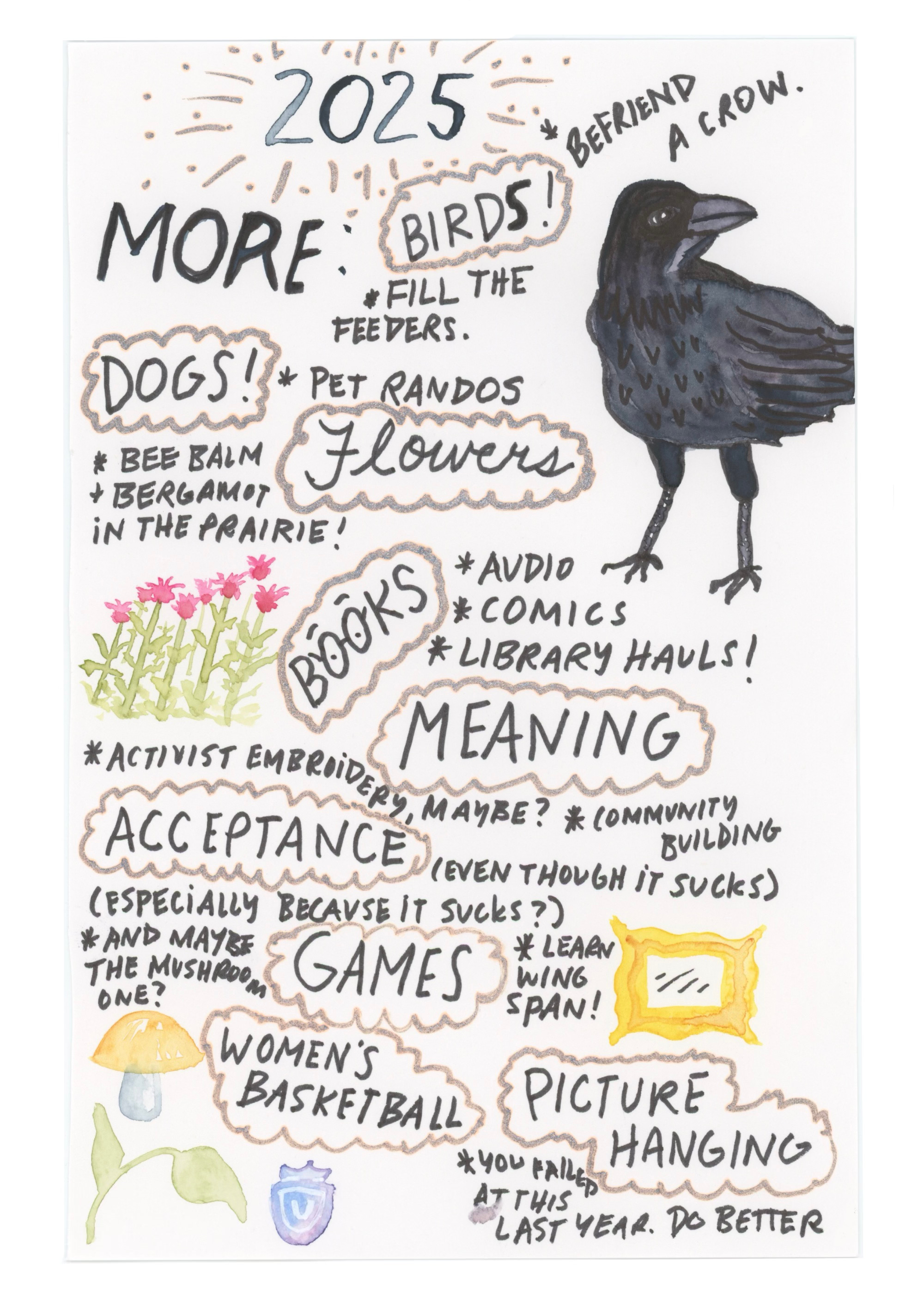
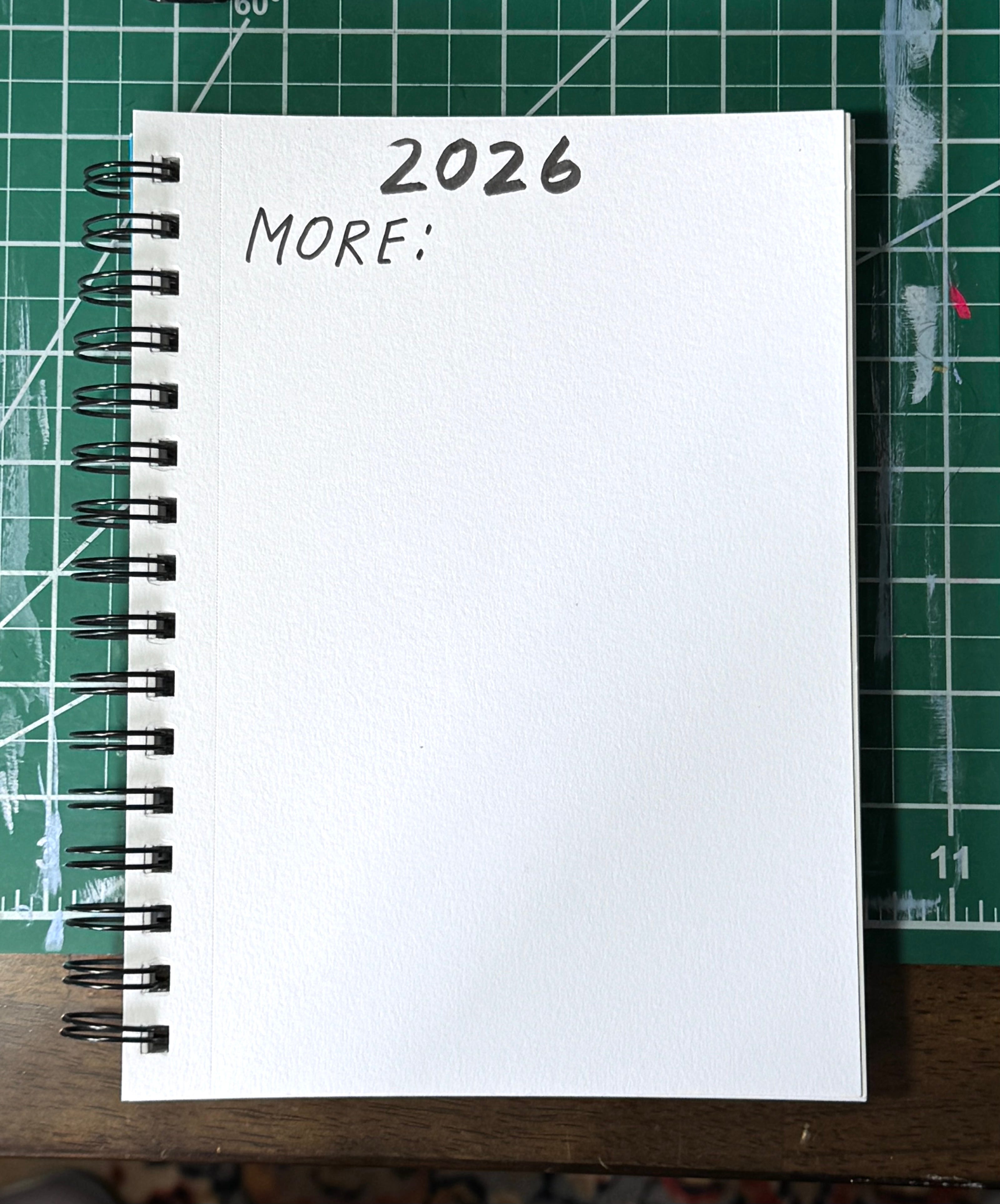
Art and writing weren’t even on the list, yet somehow everything I created last year felt tied to that piece of paper hanging over my desk. So when I sat down a few days ago in front of a blank notebook page, I panicked a little.
Intentions can be good, necessary even, especially when you’re trying to climb out of despair.
Intentions are desires, wishes, wanting. Intentions are hopeful. What I’m really hoping for is another year of writing, drawing, collaging. Trusting myself and taking creative risks. Finding a deeper peace within my body and within my life.
But what if I write it down and it doesn’t happen? What if I don’t write it down and it doesn’t happen?
Pema Chodron says “hope and fear is a feeling with two sides. As long as there is one, there is always the other.” She goes on to say that this combination feeling, this hope/fear, is the root of our pain. “[A]bandoning hope is an affirmation, the beginning of the beginning.”
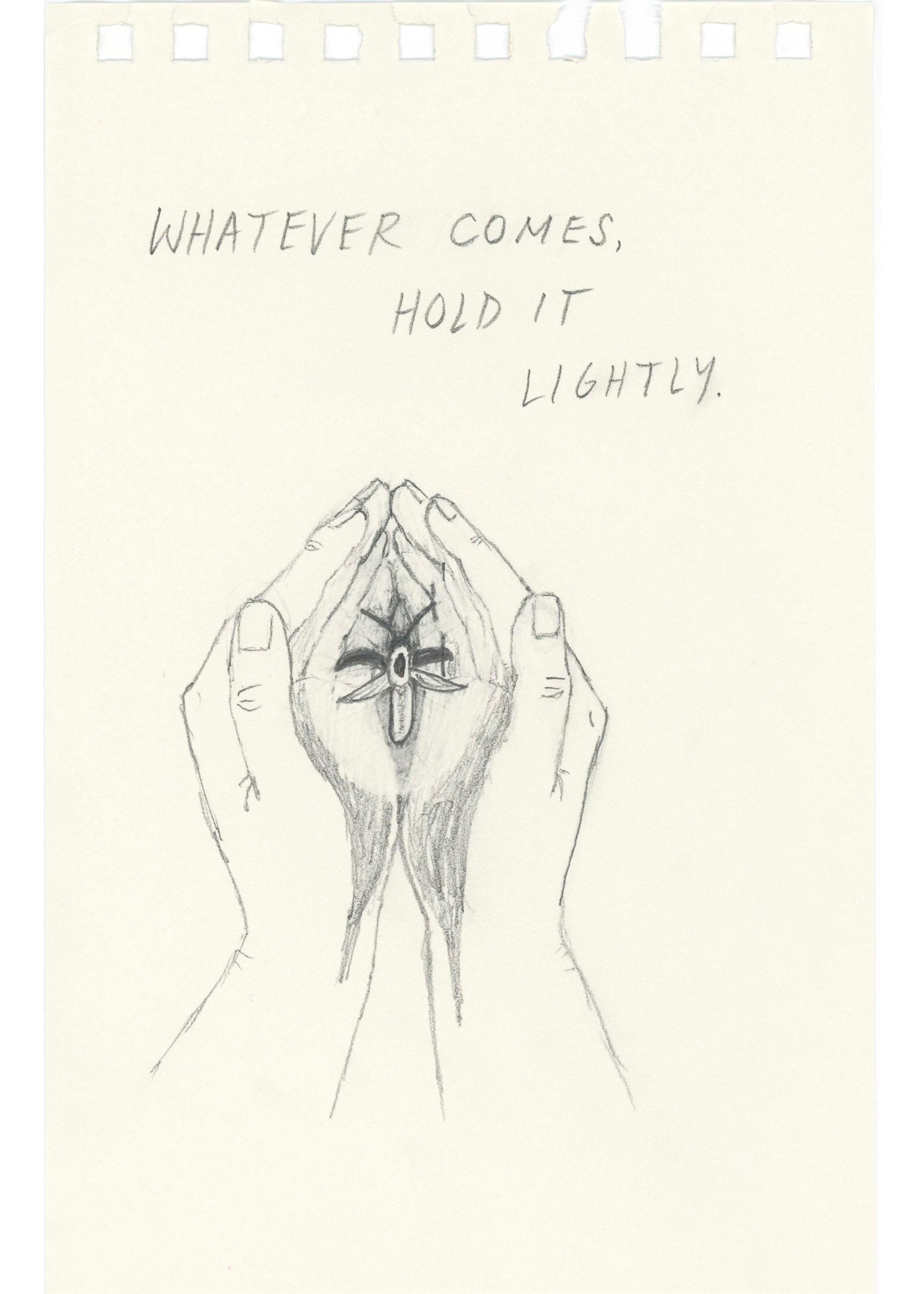
Look, I love Pema, but even if it’s good for me, I don’t want to abandon hope. I like hope, even with its sticky little underside of fear. Maybe, though, I can try to release it. To let it go, the way you’d let go of a firefly after holding your cupped hands to your eye to see it glow.
It’s so easy, this time of year, to get caught up in expectations. It’s hard to break with traditions, even if you’re the kind of person who fundamentally disagrees with New Year’s as a concept. Who thinks that the calendar really only makes sense for bureaucratic reasons, and that if we’re going to insist on celebrating a new year it should be on the vernal equinox, as it was until very recently, and that any celebration should involve ways to be kind to ourselves and our planet, instead of self-deprivation and judgement.
Not that Julia’s exercise is either of those things. It isn’t. I could absolutely make a list that reads More Acceptance, More Gentleness, More Slowness, More Stillness. But I think what I really want is to be where I am, and be open to whatever comes next. Not this year, but this season. Because while the years march forward, the seasons trace a circle. They connect, they overlap, they spiral. I would like to let them continue to birth me and bury me. I would like to stop trying to cram them into calendar squares. I would like to hold hope and fear gently, to watch them flare, see them for what they are, and let them go.
Who knows, maybe next week I’ll feel differently about all of this. Maybe I’ll fill the page with watercolor snails, or pigeons, or something I haven’t even thought of, yet. Maybe I’ll re-evaluate on March 20th, when the first shoots of green push up through the frozen ground. But for now, 2026 is blank. And for today, at least, it’s going to stay that way.
What about you? Are there any unmet goals from last year that you’ve removed the time limit on? Have you let go of any traditions this year? Are you ready to abandon hope? Or just the concept of time as linear? Wherever you’re at, I hope you’re staying warm and noticing birds.
As always, if this piece spoke to you, please consider liking, sharing, commenting, and/or subscribing! It makes the void I’m shouting into feel a lot less void-y.
I have a 2026 summoning square (created by Megan Rhiannon who is a fellow neurodivergent and chronically ill artist) which is less about goals and more things that I'd like to see happen, sort of like a bingo card. It's fun if I get to experience all of them, but less of a let-down if I don't. And it's more to remind myself of the kind of things I really want to be spending my time on.
Friend, yes. I am here for all of this. I stopped resolutions and goal setting and time-bound self-expectations a while ago (see: I am not a published novelist, and the world didn’t end). All it did was make me hate myself and ignore my needs. And I realized that I didn’t need that conceit. Whether I set goals or not, I’m gonna do what I’m gonna do.